The short answer
Victorian child workers were punished mainly with beatings and fines. In the mills, overlookers struck children with leather straps, and sometimes with heavy wooden rollers, for falling asleep, working too slowly or arriving late. Almost everywhere, children also lost part of their wages in fines for small offences like talking, lateness or untidiness. The ultimate punishment was dismissal, which could leave a whole family without enough to eat.
We know a great deal about these punishments because the children told Parliament about them. In 1832 a committee led by the MP Michael Sadler questioned former mill workers, and later commissions interviewed children in mines and factories across the country. Their evidence, together with accounts of the match factories and brickyards, paints a consistent and grim picture of how working children were kept in line. For the bigger picture, see our guide to Victorian child labour.

Beatings in the mills
The textile mills ran on long shifts, often 12 to 14 hours, and by the end of the day exhausted children struggled to stay awake and keep pace with the machines. The overlookers, the supervisors who ran each room, were under pressure to keep production up, and the usual way they did it was by hitting the children. Read more about mill children.
Matthew Crabtree, who started in a Yorkshire mill as a boy, told the Sadler Committee in 1832 that he was “most commonly beaten”. He explained that children were beaten most towards the end of the day, when they were most tired, and that the fear of a beating was what kept them working. Asked what he was beaten with, he said mainly a strap.
Some overlookers used something worse. Crabtree described the “billy roller”, a wooden rod two or three yards long that sat on top of the spinning machines, and said he had seen children’s heads broken with it. Elizabeth Bentley, another former mill child, gave the same evidence: when children fell behind, the overlookers would strap them. She also told the committee that if children did not finish their food in time, the overlooker might take it away and feed it to his pigs.
The committee’s questions were often leading, because Sadler was campaigning for reform and wanted to bring out the worst. Even so, historians regard the evidence as broadly representative, and it shocked the public enough to help pass the Factory Act of 1833.
Sources: Victorian Web: Evidence given before the Sadler Committee, Macmillan: Testimony before the Sadler Committee, The Sadler Commission: minutes of evidence (document set)
Fines and deductions
Fines were the everyday punishment of Victorian working life. Instead of a blow, a foreman would simply dock money from a child’s wages, and because pay was already so low, a single fine could wipe out a large share of a day’s earnings. Read more about how much Victorian children were paid.
The best documented example comes from the Bryant & May match factory in Bow, East London, in the 1880s. There, workers were fined 3d for having dirty feet (many could not afford shoes), for talking or for an untidy workbench, 5d for being late, and a whole shilling for leaving a burnt match on the bench. One girl who dropped a tray of matches was fined 6d. For a girl under 14 earning about 4 shillings a week, a single shilling fine meant losing a quarter of her week’s pay.
| Offence at Bryant & May | Fine |
|---|---|
| Dirty feet, talking or an untidy bench | 3d |
| Being late | 5d |
| Dropping a tray of matches | 6d |
| A burnt match left on the bench | 1s |
On top of the fines came deductions for materials. Matchgirls had to buy their own glue and brushes, and in many trades children paid for tools or uniforms out of their wages. Lateness was punished in other ways too. In some factories a worker who turned up even a few minutes late found the gates locked and lost half a day’s pay.
The fines were bitterly resented, and they were one of the main reasons the matchgirls walked out in 1888. Their victory ended the fines at Bryant & May. Read the full story of the Matchgirls’ Strike of 1888.
Sources: Wikipedia: Matchgirls’ strike, Matchgirls Memorial: The Story of the Strike
Punishment in the mines, chimneys and brickyards
Outside the mills, punishment took different forms depending on the work, but the pattern was the same: children who were slow, tired or frightened were forced on by whoever was in charge of them.
In the coal mines, the youngest children worked as trappers, sitting alone in the dark for up to 12 hours to open ventilation doors. They were not allowed to fall asleep, because a door left shut could endanger the whole pit, and a trapper caught dozing could expect rough treatment from the miners. Older children who hauled coal tubs worked for the adult miners, who often hired and paid them, and the 1842 Royal Commission heard many accounts of children being cursed at and struck to make them work faster.
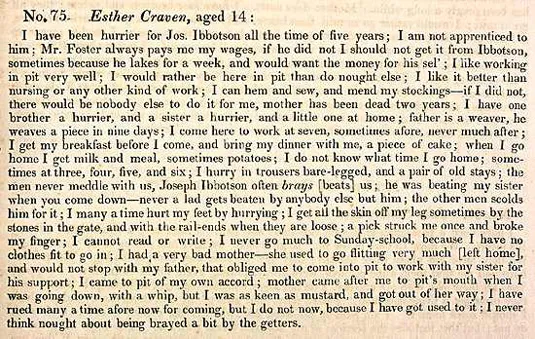
Esther Craven, a 14 year old hurrier in a Yorkshire pit, told the commissioners that the collier she worked for “often brays [beats] us”, adding that he had been beating her sister just before they arrived.
Climbing boys in the chimney sweeping trade suffered some of the cruellest treatment of all. A child who was too frightened to climb into a dark flue might have straw lit beneath him to force him upwards. Masters rubbed salt water into the raw knees and elbows of new climbers to harden the skin, and kept boys underfed so they stayed small enough for the work.
In the brickyards, clay carriers had to keep pace with the moulder, who was paid by the number of bricks he made. Reports from the 1860s describe children who were not quick enough being pushed and struck by the adults they worked for. Read more about brickfield children, or see the most dangerous Victorian jobs for children.
Sources: Historical Marker Database: Life in the Coal Mines, Workington, Victorian Child Labour, Old Mersey Times: George Smith of Coalville
Why was punishment so harsh?
Part of the answer lies in how work was organised. In many industries, the adults who supervised children were paid by results. A spinner, a moulder or a miner earned more if his team worked faster, so he had every reason to drive the children under him as hard as he could. Overlookers in the mills were judged on how much their rooms produced, and long hours made exhausted children slower as the day went on.
Attitudes played a part too. Physical punishment was normal in Victorian homes and schools, and few people thought it wrong to strike a child who was idle or careless. The Sadler Committee even asked Matthew Crabtree whether a naturally kind overlooker would still need to beat children to keep them alert through such long days, a sign of how built into the system the beatings had become.
Finally, working children had no one to protect them. Before the Factory Acts there were no inspectors, and a child who complained risked being sacked, which would hurt the whole family. Many parents depended so heavily on their children’s wages that they accepted harsh treatment as part of the job.
How the law and public opinion changed
The Sadler Committee’s evidence was published in 1832 and caused a sensation. It helped bring about the Factory Act of 1833, which limited children’s hours in textile mills and, crucially, appointed the first factory inspectors. Shorter days meant fewer exhausted children struggling to stay awake, and inspectors meant someone outside the mill was finally watching.
Over the following decades, further Factory Acts cut hours again, required dangerous machinery to be fenced and pushed the minimum working age steadily upwards. Compulsory schooling from 1880 moved the youngest children out of work altogether. Fines lasted longer in some trades, and it took the matchgirls’ strike of 1888 to end them at Bryant & May.
Public attitudes shifted too. The founding of the National Society for the Prevention of Cruelty to Children in 1889, and the Prevention of Cruelty to Children Act passed the same year, reflected a growing belief that children had a right to protection, at work and at home.
It is worth remembering that the Sadler evidence dates from 1832, just before Victoria came to the throne in 1837. The beatings it describes carried on well into her reign in many places, but the slow tightening of the law means that a working child in the 1890s was far less likely to be strapped than one in the 1830s.
Read more: Victorian Child Labour: What Jobs Did Children Do?
Frequently asked questions
How were children punished in Victorian factories?
Mostly by beatings and fines. Overlookers struck children with leather straps for falling asleep, working slowly or being late, and foremen docked money from wages for small offences. Persistent troublemakers could be sacked.
What was a billy roller?
A billy roller was a long wooden rod, two or three yards in length, that ran along the top of some spinning machines. Former mill workers told Parliament in 1832 that overlookers sometimes used it to beat children.
What were Victorian child workers fined for?
Talking, lateness, dirty feet, an untidy workbench, dropping goods and damaging work. At Bryant & May in the 1880s, fines ranged from 3d to a whole shilling.
Were Victorian children beaten for falling asleep at work?
Yes. Witnesses to the Sadler Committee said children were beaten most at the end of long shifts, when they were most tired and likely to fall asleep.
When did the punishment of child workers stop?
There was no single date. Factory inspectors from 1833, shorter hours, compulsory schooling from 1880 and the matchgirls’ victory over fines in 1888 all reduced it, and child cruelty became a crime under the Prevention of Cruelty to Children Act 1889.
Sources and further reading
- Victorian Web: Evidence given before the Sadler Committee (1832)
- Macmillan: Testimony before the Sadler Committee and the Ashley Mines Commission
- The Sadler Commission: minutes of evidence (document set)
- Wikipedia: Matchgirls’ strike
- Matchgirls Memorial: The Story of the Strike
- Historical Marker Database: Life in the Coal Mines, Workington
- Old Mersey Times: George Smith of Coalville
- Parliamentary Papers, 1831 to 1832, volume XV (Report of the Select Committee on the Factories Bill)