Children in the cotton mills
The cotton and wool mills of Lancashire, Yorkshire and Scotland employed more children than almost any other Victorian industry. In some mills there were more children on the factory floor than adults.
Mill children worked six days a week, often from 6am to 8pm, in hot, damp rooms full of cotton dust and the deafening roar of machinery. The youngest crawled under machines while they were still running. Older children walked miles each day along the spinning frames, mending broken threads.
This guide explains why mill owners relied on children, the jobs they did, what a working day was like and how the Factory Acts slowly changed life in the mills. For the bigger picture, see our guide to Victorian child labour.
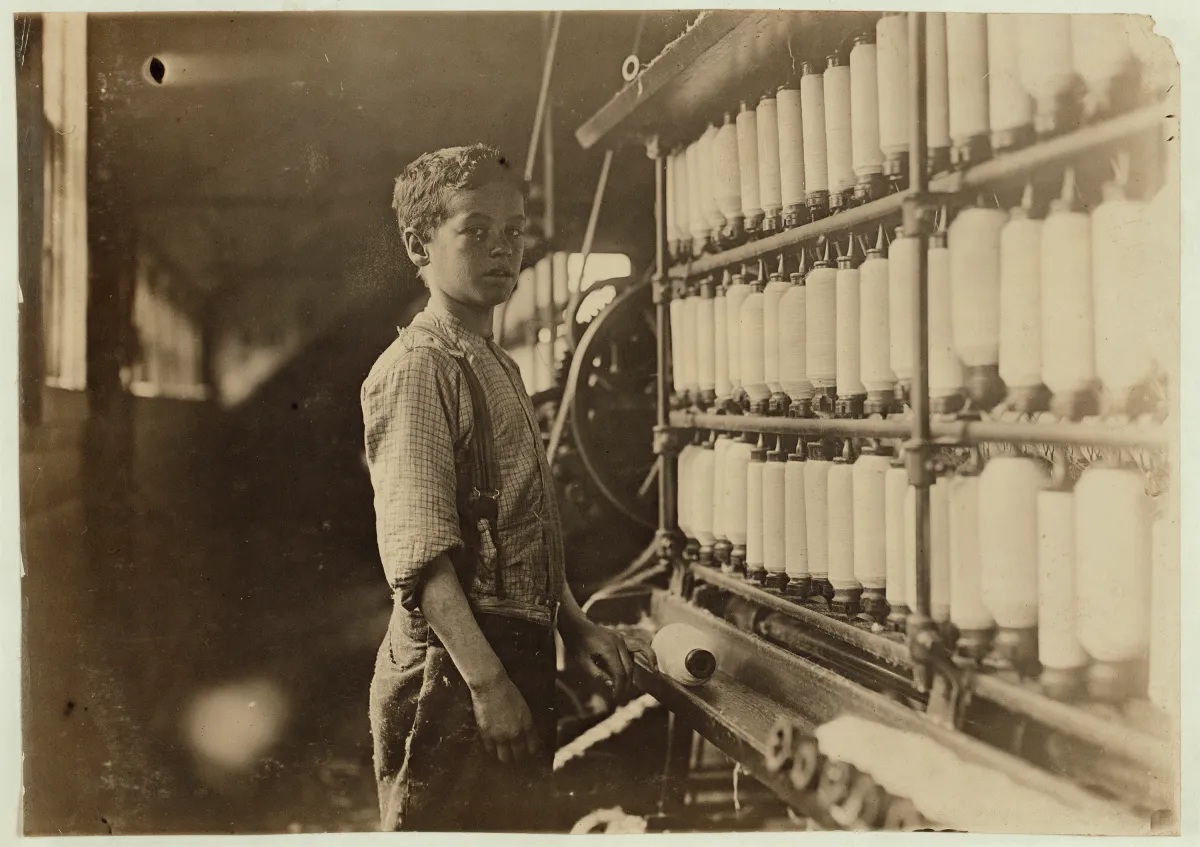
Mill children: quick facts
- Where: Cotton and wool mills, mainly in Lancashire, Yorkshire and Scotland
- Starting age: Often 5 to 9 before the law changed
- Main jobs: Scavengers and piecers
- Hours: Typically Monday to Saturday, 6am to 8pm, before the Factory Acts
- Pay: A small fraction of an adult wage; girls were paid less than boys
- Punishments: Beatings and fines for lateness, mistakes or falling asleep
- Biggest dangers: Running machinery, cotton dust and constant noise
- First real protection: The 1833 Factory Act banned under 9s from textile mills
Why mill owners wanted children
Children had always helped their families earn a living, but the Industrial Revolution changed the scale. Steam powered mills needed large numbers of workers to tend their machines, and mill owners saw children as cheap, effective labour.
- They cost less. Children worked for a fraction of an adult’s wage, and girls were cheaper still.
- They were the right size. Small bodies could reach under and between machines where adults could not fit.
- They had energy and nimble fingers. Some jobs, like joining broken threads, children could do as well as or better than adults.
- They had no rights. Children rarely complained and could be beaten or fined without consequence.
Poor families depended on their children’s wages to survive. Children from the workhouse were sometimes sent to the mills as “pauper apprentices”, with no family to protect them.
What jobs did children do in the mills?
Two jobs in the cotton mills were done almost entirely by children.
Scavengers
Scavengers were usually the youngest workers in the mill. Their job was to crawl underneath the spinning machines and gather up the loose cotton and fluff that collected on the floor. The machines were rarely stopped, so scavengers had to do this while the heavy moving parts swept back and forth just above them. One slip could cost a child their fingers, a hand or their life.
Piecers
Piecers were a little older. They walked up and down beside the spinning machines all day, watching for broken threads. When a thread snapped, the piecer leaned in and twisted the ends back together, quickly, while the machine kept running. A piecer could walk many miles in a single shift without ever leaving the room.
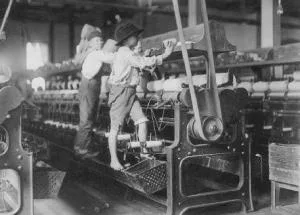
Other mill work
Children also carried bobbins and fetched and carried for adult spinners and weavers, and were given the dirtiest cleaning jobs. Beyond the cotton mills, children worked in wool and flax mills, and in other factories making pottery, glass, nails and chains.
A day in a Victorian mill
Before the Factory Acts, a normal working week ran from Monday to Saturday, from 6 in the morning until 8 at night. Children often had to walk to the mill in the dark and walk home again in the dark, with only short breaks to eat during the day.
Inside, the mill was hot and humid, because cotton thread breaks less easily in damp air. The air was thick with cotton dust and the machines made a constant, deafening noise.

Punishments
Overseers were under pressure to keep the machines running, and they kept tired children working through harsh discipline:
- Fines taken from wages for being late, talking or making mistakes
- Beatings for falling asleep or working too slowly, sometimes with a leather strap
- Shouting and threats, including the threat of losing a job the family depended on
At the factories children had no rights at all. A child who was injured or fell ill could simply be replaced.
Dangers and health
There were few safety measures in Victorian mills, so injury and even death were not uncommon.
- Machinery: Children were told to clean under and around machines while they were running. Fingers, hands, hair and clothing could be caught in moving parts.
- Cotton dust: Breathing in fibres all day caused coughing and lung disease that could last a lifetime.
- Noise: The constant roar of the machines left many mill workers partly deaf.
- Exhaustion: Fourteen hour days on their feet wore children out, and tired children were more likely to have accidents.
- Growth: Long hours of standing and stooping could damage growing bones and posture.
Until 1844, there was no law requiring dangerous machinery in factories to be fenced off.
The Factory Acts and the mills
The textile mills were the first industry Parliament tried to regulate. Reformers such as Lord Shaftesbury and Richard Oastler campaigned for decades, but change was slow because mill owners saw children as a necessary part of production, and early laws had too few inspectors to enforce them.
| Year | Law | What it meant for mill children |
|---|---|---|
| 1819 | Cotton Mills Act | Banned children under 9 from cotton mills, but had no proper inspectors |
| 1833 | Factory Act | Banned under 9s from textile mills, limited 9 to 13 year olds to 9 hours a day and 48 a week, and appointed the first factory inspectors |
| 1836 | Registration of births | Let inspectors check children’s real ages (England and Wales) |
| 1844 | Factory Act | Limited children to 6.5 hours a day with time for school, and required dangerous machinery to be fenced |
| 1847 | Ten Hours Act | Limited women and 13 to 18 year olds to 10 hours a day and 58 a week |
| 1850 | Factory Act | Set a 10.5 hour day for women and young people, between 6am and 6pm |
| 1878 | Factory and Workshop Act | Banned children under 10 from all factories and workshops |
| 1891 | Factory Act | Raised the minimum working age to 11 |
| 1901 | Factory and Workshop Act | Raised the minimum age for factory work to 12 |
The half time system
From 1844, many mill children became “half timers”, splitting their day between the mill and the classroom. It was hard on children, who often arrived at school exhausted, but it meant many mill workers learned to read and write for the first time. The half time system lasted until the 1918 Education Act. Read more about Victorian schools.
Frequently asked questions
What jobs did children do in Victorian mills?
The two main jobs were scavenger and piecer. Scavengers crawled under running machines to collect loose cotton, and piecers mended broken threads on the spinning machines. Children also carried bobbins and did cleaning jobs.
How long did children work in the mills?
Before the Factory Acts, a typical week was Monday to Saturday, 6am to 8pm. The 1833 Factory Act cut the hours of 9 to 13 year olds in textile mills to 9 a day.
What was the most dangerous job in a cotton mill?
Scavenging was the most dangerous, because children worked under machinery while it was still moving. Many lost fingers or hands, and some were killed.
How were mill children punished?
Children were fined for lateness, talking or mistakes, and beaten for falling asleep or working too slowly. Some overseers used a leather strap.
What age did children start work in the mills?
Before 1833 many started at five to nine years old. The 1833 Factory Act banned children under 9 from textile mills, and the minimum age rose to 10 in 1878, 11 in 1891 and 12 in 1901.
What was a half timer?
A half timer was a child who spent half the day working in the mill and half the day at school. The system began with the 1844 Factory Act and lasted until 1918.
Sources and further reading
- Victorian Child Labour: What Jobs Did Children Do?
- The National Archives: 1833 Factory Act
- Victorian Schools