The short answer
Most Victorian children who worked earned somewhere between a few pence a day and 3 or 4 shillings a week. A young trapper in a coal mine might take home 6d a day, a child in a cotton mill 2s 6d to 4s 6d a week, and a girl under 14 at a London match factory about 4s a week. That was a small fraction of what an adult man earned, and girls were usually paid less than boys.
Those figures hide a lot. Pay varied hugely by job, by region and by decade. Some children were paid nothing at all while they “learned” the work, many lost part of their wages to fines, and almost every penny went straight to their parents. This guide sets out what children in different jobs actually earned, according to the reports and witnesses of the time, and what that money was worth. For the jobs themselves, see our guide to Victorian child labour.

Understanding Victorian money
Before decimal currency arrived in 1971, British money was counted in pounds, shillings and pence, written as £ s d. There were 12 pennies in a shilling and 20 shillings in a pound, so a pound was worth 240 pennies.
| Coin or amount | Written as | Worth |
|---|---|---|
| Farthing | ¼d | A quarter of a penny |
| Halfpenny | ½d | Half a penny |
| Penny | 1d | The basic unit |
| Shilling | 1s | 12 pennies |
| Half a crown | 2s 6d | 30 pennies |
| Pound (a sovereign) | £1 | 20 shillings, or 240 pennies |
So when a factory record says a child earned “2s 6d a week”, it means two shillings and sixpence, or 30 pennies. A wage of 6d a day, six days a week, comes to 3s a week.
What children earned in different jobs
The best evidence for children’s pay comes from the government inquiries of the period, especially the Factories Inquiry Commission of 1833 and the Children’s Employment Commission of 1842, which questioned employers and children directly. The figures below come from those reports and from later accounts of particular trades.
| Job | Place and date | Pay recorded |
|---|---|---|
| Mill children under 8 | Walker and Edmondson’s mill, Mytholmroyd, 1833 | 2s 6d a week, rising to 3s by age 13 |
| Mill children aged 9 and up | Bellhouse mill, Manchester, 1833 | Up to 4s 6d a week (above the local average) |
| Trapper (air-door boy) | South Wales collieries, 1842 | 6d to 8d a day |
| Matchgirl under 14 | Bryant & May, Bow, 1880s | About 4s a week, before fines |
| Matchbox maker at home | East London, 1880s | 2¼d to 2½d for 144 boxes, buying her own glue and string |
In the mills
The 1833 commission found children under eight at a mill in Mytholmroyd, in the Calder valley, working a 77 hour week for 2s 6d, rising to just 3s by the time they turned 13. In Manchester, the Bellhouse family’s mill paid children up to 4s 6d a week, which was better than most. Some new workers earned nothing at all at first. Ellen Hooton, a Wigan girl who gave evidence in 1833, received no wages for her first six months, on the grounds that she was only being trained. Read more about mill children.
In the mines
The 1842 report on the South Wales collieries described the air-door boys, the children who sat alone in the dark opening ventilation doors, as earning between 6d and 8d a day. Six days at 6d came to 3s a week, broadly in line with the mills, though the work was even more frightening and dangerous.
In the match trade
At Bryant & May in the 1880s, girls under 14 earned about 4 shillings a week. But fines for talking, dirty feet or lateness could take a large bite out of that. Worse off still were the women and children who made matchboxes at home, paid only 2¼d to 2½d for every gross (144) of boxes and expected to buy their own glue and string. Read more about the matchgirls.
On the streets
Street children had no wage at all. Newsboys, flower sellers and crossing sweepers lived on whatever they could make, which rose and fell with the weather and the news. The Shoeblack Brigades gave some boys a more reliable income. During the Great Exhibition of 1851, about 25 brigade boys earned more than £500 between them over the summer, and each boy kept a third of his daily takings, with a third saved for him and a third paying for his keep.
Sources: Calderdale Council: Factory conditions, David Bellhouse: Bellhouse family history, Wikipedia: Ellen Hooton, Amgueddfa Cymru: Children’s jobs in the mines, Wikipedia: Matchgirls’ strike, Children’s Homes: Shoeblack Brigades
How children’s pay compared with adults
To see how little these wages were, it helps to set them against adult pay. The historian Liza Picard puts the average London labourer’s wage at between 20 and 30 shillings a week, with lower pay in the provinces. A mill child on 3s a week, or a trapper on 6d a day, was earning roughly a tenth of that.
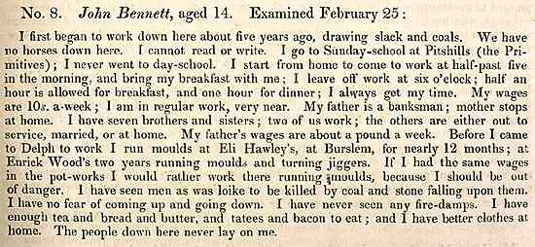
Skilled men such as cotton spinners earned more again, and in many mills they hired and paid the child piecers who worked for them, so the children’s wages came out of the man’s pocket rather than the owner’s. That was one reason so many piecers were the sons and daughters of the spinners they worked beside.
Girls were nearly always paid less than boys for the same work, and women less than men.
One caution about dates. Some of the best known figures, like the 1833 mill wages, come from just before Victoria’s reign began in 1837. Wages changed only slowly over the following decades, so they give a fair picture of the early Victorian years, but pay in the 1880s and 1890s was generally a little higher.
Sources: Liza Picard, via Brewminate, Calderdale Council: Factory conditions
Where the money went
A working child almost never kept their own wages. Pay was usually handed to a parent, sometimes straight from the employer, and it went on rent, food and fuel for the whole household. Ellen Hooton told the 1833 commission that her mother took all her wages, a story repeated by countless other children.
For poor families this money was not a luxury. When a father was ill, out of work or dead, the earnings of two or three children could be all that stood between the family and the workhouse. That is why many parents resisted the Factory Acts and why some lied about their children’s ages to get them into work sooner.
Wages could also shrink before they ever reached home. Fines for lateness, talking or mistakes were deducted directly, and in some trades children had to pay for their own materials. At Bryant & May, girls bought their own glue and brushes and paid the boys who brought frames from the drying ovens. The Shoeblack Brigades charged boys for their uniforms and brushes out of their earnings, although they also saved a third of the money for each boy.
Sources: Wikipedia: Ellen Hooton, Wikipedia: Matchgirls’ strike, Children’s Homes: Notting Hill Shoeblack Society
What would their pay be worth today?
Converting Victorian money into today’s pounds is trickier than it looks, because there is more than one honest way to do it.
The simplest method adjusts for prices. Using the Office for National Statistics composite price index, £1 in 1850 had about the same buying power as £175 today. On that basis a shilling was worth roughly £8.75 and a penny about 73p.
| Victorian wage | Price adjusted value today (approx.) |
|---|---|
| 6d a day (a trapper) | £4.40 a day |
| 2s 6d a week (a young mill child) | £22 a week |
| 4s a week (a matchgirl under 14) | £35 a week |
| 4s 6d a week (a well paid mill child) | £39 a week |
Those numbers make Victorian wages look even more meagre than they were, because many everyday goods, especially food, are far cheaper today relative to other things. Economists at MeasuringWorth point out that comparing earnings with earnings, rather than with prices, gives a much higher figure. By that measure, a penny loaf of bread in 1880 cost the equivalent of nearly £2 in today’s wages, around five times its price adjusted value.
Whichever method you use, the picture is the same. A child working 70 or more hours a week took home a sum that would barely cover a few meals today, and it was handed over to help keep a whole family alive.
Sources: Official Data: UK inflation since 1850 (ONS composite price index), MeasuringWorth: A loaf of bread for a penny in 1880, Victorian Web: Inflation and the value of the pound
Frequently asked questions
How much did Victorian children earn a week?
Most earned between about 2s 6d and 4s 6d a week in mills and factories, with similar amounts for young children in the mines. Street children had no fixed wage and earned whatever they could.
How much did a Victorian child earn in a day?
A trapper in a South Wales coal mine in 1842 earned 6d to 8d a day. Over a six day week, that came to roughly 3s to 4s.
Did Victorian children keep their wages?
Rarely. Most handed their pay to their parents to help with rent, food and fuel.
Were girls paid less than boys in Victorian times?
Yes. Girls were usually paid less than boys for the same work, and women less than men.
How much is a Victorian shilling worth today?
Adjusted for prices, a shilling from 1850 is worth roughly £8.75 today. Compared with wages rather than prices, its value is several times higher.
Why were Victorian children paid so little?
Employers saw children as cheap labour, families were desperate for any income, and for most of the period there were no laws setting minimum pay. Children could also be fined or dismissed with no one to stand up for them.
Sources and further reading
- Calderdale Council: Factory conditions and the 1833 Factories Inquiry Commission
- David Bellhouse: Bellhouse family history, cotton spinners
- Wikipedia: Ellen Hooton
- Amgueddfa Cymru: Children’s jobs in the mines (1842 report extracts)
- National Coal Mining Museum: Extracts from the 1842 Children’s Employment Commission
- Wikipedia: Matchgirls’ strike
- Children’s Homes: Shoeblack Brigades
- Liza Picard, The working classes and poverty in the Victorian era (Brewminate)
- Official Data: UK inflation since 1850
- MeasuringWorth: A loaf of bread for a penny in 1880
- Victorian Web: Inflation and the value of the pound