Newsboys on the streets of Victorian Britain
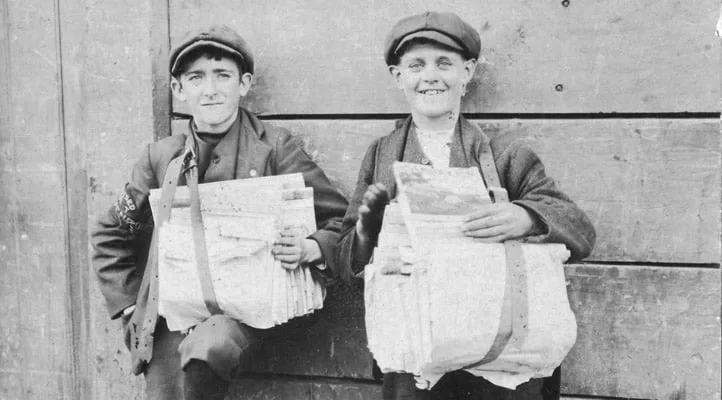
By the end of the Victorian era, you could not walk through a British city without hearing them: ragged boys on every busy corner, waving the latest edition and bellowing the headlines. A murder, a war, a prime minister resigning or the day’s racing results could all be sold at a halfpenny a time.
Newspaper selling was one of the most common street jobs for poor children. Unlike work in a mill or mine, it needed no employer and no skill, just a few coppers to buy the first papers and a voice loud enough to be heard over the traffic. For many boys it was a way to earn money for the family, and for some it was the only way to survive.
This guide explains how cheap newspapers created the newsboy, how the trade worked, what boys earned and the risks they faced on the streets. For other children who worked the streets, see our guide to Victorian child labour.
Victorian newspaper boys: quick facts
| Who | Mostly poor boys, some as young as 7 or 8, and some girls |
| Where | Street corners, railway stations, factory gates and steamboat piers |
| What they sold | Mainly evening papers and late editions |
| Price | Usually a halfpenny or a penny a copy |
| How they earned | Bought papers in bulk and kept the difference on each copy sold |
| Busiest times | Evenings, and whenever big news broke |
| What made it possible | The end of newspaper stamp duty in 1855 and cheap halfpenny evening papers |
| Regulation | The Employment of Children Act 1903 let councils control street trading by children |
Sources: The Peel Web, Victorian Web: The Echo
How cheap newspapers created the newsboy
At the start of Victoria’s reign, newspapers were a luxury. Every copy carried a government tax called stamp duty. It had been raised to 4d a sheet in 1815, and although it was cut to 1d in 1836, most papers still cost several pence. Working people often shared a single copy or listened to it read aloud in the pub.
Campaigners called these duties “taxes on knowledge”, and in June 1855 the newspaper stamp duty was finally abolished. Within months the Daily Telegraph went on sale at a penny, and dozens of cheap new papers appeared across the country. The removal of the tax on paper itself followed in 1861, making papers cheaper still.
The halfpenny evening paper
The real turning point for newsboys was the cheap evening paper. In 1868 the Echo launched as London’s first respectable halfpenny paper. Newsagents refused to stock it because the profit was so small, so its publisher sent out a brigade of boys, and some girls, to sell it on the streets instead. It came out in several editions through the afternoon, each with the latest news, share prices and racing results.
More followed, including the Evening News in 1881 and The Star in 1888. In cities across Britain, halfpenny evening papers were sold at factory gates as workers headed home, and street sellers were the fastest way to get each new edition into readers’ hands.
Sources: The Peel Web, Victorian Web: The Echo, Wikipedia: The Evening News, Press Gazette, Fleet Street Heritage
How the newspaper trade worked
Newsboys were not employees. They were tiny businesses. A boy bought a bundle of papers from the publisher’s office or a wholesaler, then sold them on the street for a little more than he had paid. The difference was his profit, so every unsold paper was money lost.
Papers were often bought by the quire. Henry Mayhew, who interviewed London street sellers in the mid 1800s, was told there were 27 papers to a quire.
Second editions and late news
Much of the street trade was in “second editions” or “seconds”, the later editions of the papers with the freshest news. Mayhew’s sellers explained that the trade depended entirely on what had happened that day. A sensational trial verdict or a prime minister’s resignation could sell out a bundle in minutes. A quiet news day could leave a boy with a pile of papers nobody wanted.
Shouting the headlines
A newsboy’s voice was his main tool. Boys shouted the biggest story of the day, or a dramatic version of it, to grab the attention of passers by. Street sellers were known for exaggerating, and Mayhew described sellers who had a speech ready based on whatever the papers said, true or not. For more of the language heard on the streets, see our guide to Victorian slang.
Pitches
The best spots were outside railway stations, at busy crossings, near theatres and at factory gates at going home time. Older boys guarded good pitches fiercely, and fights between rival sellers were common.
Sources: Mayhew, London Labour and the London Poor: Of the Sellers of Second Editions, Mayhew: Street-sellers of Newspapers, Press Gazette
Life on the streets
Selling papers looked like freedom compared with a mill or a mine, but it was a hard life.
Evening papers meant working late into the night, often after a day at school or another job, or instead of school altogether. Newsboys stood outside in rain, fog and freezing cold, many of them barefoot and in thin clothes, and darted between horse drawn cabs, omnibuses and carts to reach their customers.
The money was never reliable. Earnings rose and fell with the news, and bad weather or a dull day could send a boy home with nothing. Reformers also worried about the company boys kept on the streets, where gambling, drink and theft were never far away and adults were ready to exploit them.
There was trouble with the police, too, because street selling broke local rules in some places. In 1870 a London paper reported small boys being taken before a magistrate after a City police raid on newsboys.
Many newsboys were not homeless, but some were. Orphans and runaways sold papers by day and slept in lodging houses, doorways or under arches at night.
The law steps in
By the 1890s, councils and reformers were studying street trading children closely. Liverpool set up a special committee in 1898, and a 1902 report for the Board of Education examined the lives of boys selling on Manchester’s streets.
The Employment of Children Act 1903 banned the youngest children from street trading and gave local councils the power to make by-laws controlling it, including licences for young street sellers. It was the first national law aimed squarely at children like the newsboys.
Sources: The Days’ Doings, 20 August 1870 (Villanova Digital Library), University of Wisconsin digital collections: reports on street trading, Report of the Departmental Committee on the Employment of Children Act, 1903
Help for street boys
Victorian charities saw street boys as both a problem and a cause, and several kinds of help grew up during the period. Ragged schools offered free lessons to children too poor or too scruffy for ordinary schools, often in the evenings so that working children could attend. Uniformed brigades such as the Shoeblack Brigade gave street boys a uniform, a fixed pitch and a share of their earnings, to keep them honest and off the streets at night.
Children’s homes took in those with nowhere else to go. Dr Barnardo opened his first homes from 1867, and many of the boys he rescued had sold papers or matches to survive. In the big cities, boys’ clubs and missions ran evening clubs, cheap meals and night shelters for working lads.
After 1870, new board schools meant every child had a school place, and compulsory schooling from 1880 slowly pulled the youngest sellers off the streets during the day. Older boys carried on selling papers after school, a tradition that lasted well into the 20th century. Read more about Victorian schools.
Frequently asked questions
What did Victorian newspaper boys do?
They bought newspapers in bulk and sold them on the street, shouting the headlines to attract customers. They kept the difference between what they paid and what they sold the papers for.
How old were Victorian newsboys?
Most were boys aged roughly 8 to 16, though some were younger. A few girls sold papers too.
How much did a Victorian newspaper cost?
After the stamp duty was abolished in 1855, many papers cost a penny. From 1868 the first halfpenny evening papers appeared, and by the 1880s halfpenny evening papers were common.
Where did newsboys sell papers?
At the busiest places in town: railway stations, street corners, crossings, theatres and factory gates when workers were heading home.
Why did newsboys shout?
A loud cry was the only way to get noticed in a crowded street. Boys shouted the biggest story of the day, sometimes exaggerating it to sell more copies.
When were newsboys regulated?
The Employment of Children Act 1903 banned the youngest children from street trading and let local councils license and control children selling on the streets.
Sources and further reading
- Henry Mayhew, London Labour and the London Poor: Of the Sellers of Second Editions
- Henry Mayhew: Street-sellers of Newspapers
- The Peel Web: The Unstamped Press
- Victorian Web: The Echo
- Wikipedia: The Evening News (London)
- Press Gazette: Local newspapers in Victorian times
- Fleet Street Heritage: Edward Lloyd
- The Days’ Doings, 20 August 1870
- E. B. Campagnac and C. E. B. Russell, report on boys engaged in street trading in Manchester, Board of Education (1902)