The shoe-shine boys of Victorian London
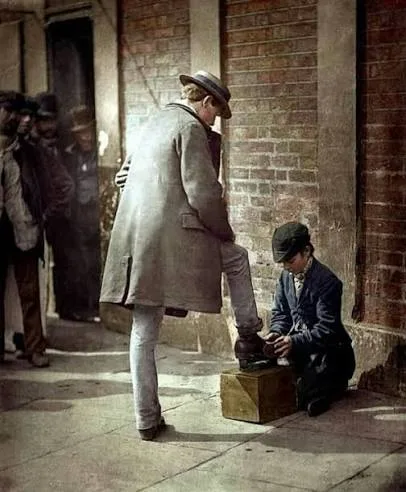
In the spring of 1851, Londoners noticed something new on their streets. Boys in bright red coats had appeared at busy corners with a brush, a pot of blacking and a little wooden box, offering to polish the boots of anyone passing by. Punch joked about the invasion of red coats, but the boys were no soldiers. They were the first members of the Shoeblack Brigade, and most of them had been homeless only weeks before.
Bootblacks, or shoeblacks, had worked the city’s streets long before then, scraping a living alongside the crossing sweepers and newsboys. What changed in 1851 was that a group of reformers turned shoe cleaning into a way out of poverty, with a uniform, a bed, a savings account and lessons every evening.
This guide looks at why Victorian Britain needed so many shoeblacks, how the brigades worked and what became of the boys who joined them. For the wider story, see our guide to Victorian child labour.
Bootblacks: quick facts
| First brigade | The Ragged School Shoeblack Society, London, 1851 |
| Founders | John MacGregor, with the backing of Lord Shaftesbury |
| Why then | To give poor boys work during the Great Exhibition of 1851 |
| Ages | Usually 13 to 16 on joining, staying until about 18 |
| Uniform | Each brigade had its own colours; the first wore red coats |
| Earnings | Split three ways: a third for keep, a third saved, a third to the boy |
| Brigades | Around a dozen in London, plus others in cities such as Leeds, Manchester and Dublin |
Sources: Children’s Homes: Shoeblack Brigades, London Museum
Why Victorian Britain needed shoeblacks
Victorian streets were filthy. Tens of thousands of horses pulled cabs, omnibuses and carts through the city every day, and the roads were thick with mud and dung. Anyone walking to work or to an appointment arrived with their boots caked in it.
At the same time, appearances mattered enormously. A gentleman, a clerk or a shop worker was judged by the state of his boots, and a dull or muddy pair suggested carelessness or poverty. Leather boots were cleaned with blacking, a paste or liquid polish, and brushed until they shone.
Wealthy households had servants, often a boot boy, to clean the family’s shoes every morning. Everyone else had to do it themselves, or pay someone on the street to do it for them. That was the bootblack’s trade: a quick polish on the corner for people who wanted to look respectable but had no servant to do it.
Bootblacks before the brigades
Street shoe cleaners had been a familiar sight in Georgian London. The trade faded in the early 1800s, partly because cheap bottled blacking from firms such as Day and Martin made it easy for people to polish their own boots at home. By the start of Victoria’s reign, the old shoeblacks had largely disappeared.
The ragged boys who still offered to clean boots on the street worked alone and without protection. They had no fixed pitch, no one to look after their earnings and nowhere safe to sleep, and the police often treated them as little better than beggars or thieves. A boy might earn a few pennies in a morning and lose them by nightfall to an older boy, a lodging house or a gambling game.
Even after the brigades arrived, these independent boys carried on. Reports from the 1850s describe brigade boys and “non-Society” boys working the same streets, with the brigades keeping a careful eye on their rivals.
Sources: Risky Regencies, drawing on Chambers’ Book of Days (1869), University of New Brunswick newspaper archive
The Shoeblack Brigade
The idea began at a meeting of ragged school teachers on 28 November 1850. London was preparing for the Great Exhibition the following summer, which would bring huge crowds to the city, and the teachers wanted to find honest work for the poor boys in their classes. Cleaning visitors’ boots seemed an obvious answer.
The driving force was John MacGregor, a barrister and philanthropist who sat on the committee of the Ragged School Union, and he had the strong support of Lord Shaftesbury, the union’s president. In January 1851 the first recruit gave a demonstration at a public meeting at the Field Lane Ragged School, and by the spring the red-coated boys were at work.
The Exhibition was a triumph for them. On average about 25 boys worked through the summer, cleaning around 101,000 pairs of boots and earning more than £500 between them. When the Exhibition closed in October, five of the boys emigrated to America to start new lives.
A dozen brigades in different colours
The success of the first brigade, which became known as the Central or “Reds” Shoeblack Society, inspired others across London. Each had its own uniform, so customers and police could tell at a glance which society a boy belonged to.
| Brigade | Founded | Uniform |
|---|---|---|
| Ragged School / Central (“Reds”) | 1851 | Red jacket |
| East London (“Blues”) | 1854 | Blue guernsey |
| South London | 1854 | Red guernsey with black collar |
| North-West London | 1857 | Red with black facings and a check cap |
| West London | 1857 | Purple, later blue with red facings |
| St Vincent de Paul (Roman Catholic) | 1857 | Blue with red cuffs |
| Islington and North London | 1858 | Brown guernsey |
| Union Jack | 1868 | Blue with white facings |
| Notting Hill | 1869 | Blue tunic |
| Tower Hamlets Mission | 1873 | Red guernsey with dark blue facings |
Several brigades deliberately took in boys who were deaf or physically disabled, who would have struggled to find any other work. The Union Jack Brigade in Limehouse became linked to Dr Barnardo’s homes from 1875. Brigades were also set up outside London, including Leeds in 1869, Manchester in 1871 and Dublin in 1879.
How the brigades worked
The rules were strict but fair. The police gave each brigade its pitches, known as stations, and boys were moved round them twice a week so that everyone took a turn at the busiest and most profitable spots. In some brigades, the best stations were a reward for good behaviour.
Every evening the boys handed over all their earnings. In most brigades the money was split three ways: a third paid for the boy’s keep, a third went into his own savings account and a third was given back to him to spend. Uniforms, brushes and blacking were supplied by the society and paid for out of the boy’s wages.
Boys usually joined at 13 to 16 and could stay until about 18. When they left, the society helped them find a steady job, join the army or navy, go to sea or emigrate to Canada or America.
Sources: Children’s Homes: Shoeblack Brigades, Children’s Homes: Central (Reds) Shoeblack Society, Children’s Homes: East London Shoeblack Society, Children’s Homes: Tower Hamlets Mission Brigade, London Metropolitan Archives: John MacGregor, Punch, 1851
A day in the life of a brigade boy
A brigade boy’s day started early at the society’s home, where many of the boys slept in a shared dormitory. In the 1880s the Central Society had about 70 boys, around 45 of whom lived at its home on Saffron Hill in Clerkenwell. The East London home in Whitechapel could take up to 80.
After breakfast he pulled on his uniform, collected his box, brushes and blacking, and walked to his station for the day. That might be a quiet side street or, if it was his turn, a prime spot outside a railway terminus or near the City where clerks and businessmen hurried past all day. He knelt on the pavement, set his box down, and called out to passers by, scraping off mud and brushing each boot to a shine for every customer who stopped.
In the evening he returned to the home and handed over his takings. Supper came next, paid for out of his earnings, and then lessons. The Central Society held an evening school four nights a week, and other brigades offered classes, Bible readings, newspapers, games and even a gymnasium. At Notting Hill, the boys’ club stayed open until 10pm five nights a week.
It was hard, cold work, done in all weathers on the open street. But compared with the life most of these boys had known before, sleeping rough, stealing or begging, it offered something rare: regular meals, a safe bed, money in the bank and a chance to learn to read and write. Read more about Victorian schools, including the ragged schools.
Sources: Children’s Homes: Central (Reds) Shoeblack Society, Children’s Homes: Notting Hill Shoeblack Society, Children’s Homes: North-West London Shoeblack Society
What became of the shoeblacks
For many boys, the brigade was a stepping stone. Some homes added industrial training alongside the shoe cleaning. At the East London Society, for example, boys learned brush making, bag making, printing and how to manufacture blacking and ink, skills that could lead to a steady trade.
Others left for the armed forces or for a new life overseas. The Tower Hamlets Mission recorded in 1890 that six of its boys had been sent to Canada with a full outfit in 1888, five had joined the army, and several had gone back to former employers who asked for them.
The brigade idea also spread beyond shoe cleaning. Reformers used the same model of uniforms, stations, rules and evening classes to set up messenger and parcel brigades, giving boys work carrying letters and packages around the city. Historians of youth movements see the shoeblack brigades as early forerunners of later uniformed organisations for boys.
By the end of the century, though, the brigades were in decline. Better schooling, new laws on child employment and cleaner, paved streets all reduced the need for them. The Notting Hill Brigade had closed by the 1890s and the East London Society by the early 1900s, while the Central Society and the North-West London Brigade seem to have ended around the First World War.
The trade itself never quite vanished. Shoe-shine stands can still be found in London today, a small reminder of the red-coated boys of 1851.
Sources: Children’s Homes: East London Shoeblack Society, Children’s Homes: Tower Hamlets Mission Brigade, Boys’ Brigade Museum: Before the BB, Children’s Homes: Shoeblack Brigades
Frequently asked questions
What was a bootblack?
A bootblack, or shoeblack, was someone who cleaned and polished boots and shoes on the street for a small fee. In Victorian Britain most were boys.
What was the Shoeblack Brigade?
It was a charity scheme started in London in 1851 by John MacGregor, with the support of Lord Shaftesbury and the Ragged School Union. It gave poor and homeless boys a uniform, a pitch to work from, somewhere to live and evening lessons.
Why did the shoeblacks wear red coats?
The first brigade, the Ragged School or Central Society, wore red jackets, which made its boys easy to spot and marked them out as members of a supervised society. Later brigades picked their own colours, including blue, brown and purple.
How old were Victorian shoeblacks?
Brigade boys usually joined between 13 and 16 and stayed until about 18. Independent street bootblacks could be much younger.
What happened to the money shoeblacks earned?
In most brigades, a boy’s daily earnings were split into thirds: one third paid for his keep, one third went into his savings and one third was his to spend.
When did the Shoeblack Brigades end?
Most had closed by the early 1900s, and the last of the original London brigades seem to have ended around the First World War.
Sources and further reading
- Children’s Homes (Peter Higginbotham): Shoeblack Brigades
- Children’s Homes: Ragged School / Central (Reds) Shoeblack Society
- Children’s Homes: East London Shoeblack Society
- Children’s Homes: Notting Hill Shoeblack Society
- Children’s Homes: Tower Hamlets Mission Shoeblack Brigade
- London Museum: Shoeblack Society sketch by John MacGregor, 1851
- London Museum: Shaftesbury, or Lost and Found
- London Metropolitan Archives: John MacGregor papers
- Punch, 1851: Reflections in a Bright Shoe
- Boys’ Brigade Museum: Before the BB
- Peter Higginbotham, Children’s Homes: A History of Institutional Care for Britain’s Young (2017)